Last week, the Season 4 Desert Vipers Sustainability Match Report was released, so this blog takes a look at some of the key messages from the document.
The Sustainability Match is an annual celebration to highlight the team’s sustainability work that takes place throughout the year, whilst also measuring the environmental impact of the event to identify opportunities for future reductions. The Sustainability Match is a key moment in the Desert Vipers calendar, bringing together sustainability initiatives, community engagement activities, and innovation trials designed to highlight how sport can contribute to a more sustainable future.
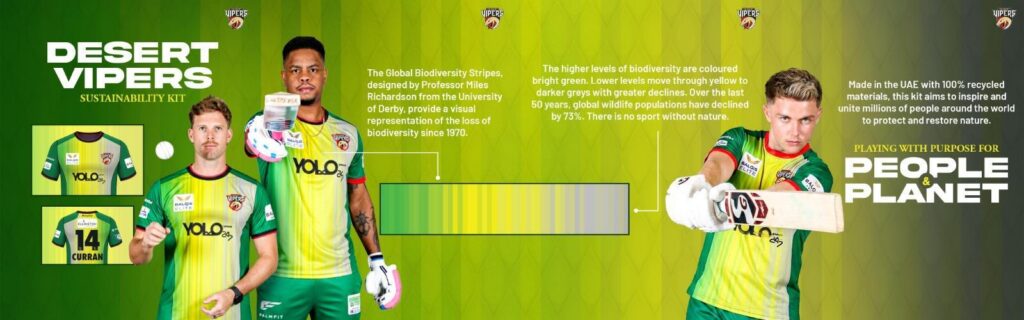
One of the key messages of the Season 4 Sustainability Match was “Without Nature, There Is No Sport.” This theme was brought to life through a range of initiatives aimed at raising awareness of biodiversity – the variety of plant and animal life in the world – and encouraging more sustainable behaviours. A specially-designed Sustainability Match jersey featuring the “Global Biodiversity Stripes’, designed by Professor Miles Richardson from the University of Derby, was worn by players to highlight the 73% decline in average recorded wildlife populations over the last 50 years. By visualising wildlife decline through the kit design, the initiative aimed to raise awareness of biodiversity loss among fans and viewers. It highlighted the critical role that healthy natural ecosystems play in sustaining sport.
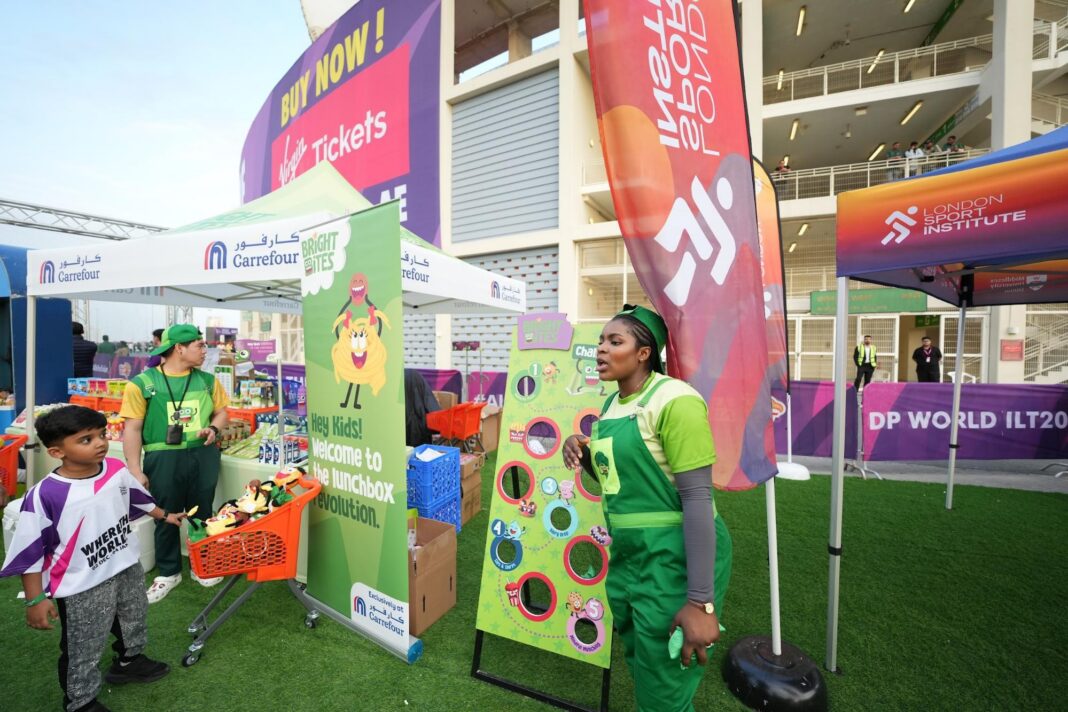
The matchday experience featured a number of fan engagement activities in the Crickmas Village designed to connect families with sustainability themes. These included Schools Programme minigames and the Bright Bites initiative from Carrefour MAF, which promoted healthier food choices through fan engagement. The matchday experience also welcomed People of Determination from BYTE inclusive affairs group, many of whom attended a cricket match for the first time, reinforcing our commitment to inclusion and the belief that sustainability in sport must also include social impact.
The report also outlines a number of innovation trials carried out during the match. This included efforts to optimise stadium energy use by turning air-conditioning off in selected areas before the end of the match. Bluewater Group’s next-gen LED water filtration units were also used, reducing the need for single-use plastic bottles while showcasing a more sustainable hydration solution that also integrates into commercial and broadcast requirements. Finally, we tested new fuel-efficiency solutions in partnership with Fuelre4m. You can find out more about our work with Fuelre4m here.
The report shows that the total emissions associated with the Sustainability Match were 45.8 tCO2e. This includes emissions across all matchday categories including stadium operations, travel, kit, and other event-related activities. The largest source of emissions was from Electricity (14.8 tCO2e), followed by Fan Travel (13.6 tCO2e), and Generators (5.1 tCO2e).
Land-use food labels were added in the SIXES Hospitality Lounge. Introduced for the first time this year, the labels aimed to help guests better understand the environmental implications of food choices.
As stadium operations sit outside our direct control, we will continue collaborating with the League, venue operators, and partners to explore solutions that can help reduce emissions in future Sustainability Matches.
By analysing the event in the Season 4 Sustainability Match Report, the Desert Vipers continue to build a clearer understanding of how cricket matches can be delivered more sustainably while inspiring fans and communities. Thank you to everyone who was a part of the momentous day! We look forward to the Season 5 Sustainability Match with anticipation.
Click here to access the full report.
Sustainability Spotlight: Vuelta Carbon
The Desert Vipers’ approach to reduction of carbon emissions in Season 4 focused first on measurement and reduction, followed by offsetting unavoidable emissions. In partnership with Vuelta Carbon, the emissions from the Sustainability Match will be completely offset through verified projects. This reduction-first approach ensures that offsetting acts as a supporting measure, helping to maximise overall positive impact while longer-term emission reductions are pursued.