Home Blog Page 25

Sport and Wellbeing: The Important Role That Sports Teams Can Play in Their Communities

1

Desert Vipers Boost Local Dubai Communities: Prioritising Mental Wealth

As the excitement builds for the third season of the DP World ILT20, the Desert Vipers are gearing up for another strong campaign leading up to January 2025. Preparations on the pitch are in full swing, with our retentions and direct signings confirmed – all that awaits is the confirmation of our local UAE talent. Beyond the pitch, we’re equally committed to strengthening our team by linking mental wealth and sustainability. This season, we’re proud to introduce new initiatives and partnerships that support our holistic approach to sport.

The Importance of Mental Wealth: Introducing Sanj Sandhu

At the Desert Vipers, we believe in community and recognise that human performance goes beyond simply having the skill: it’s about being able to execute that skill. As our Community Programme expands, I, Sanj Sandhu, have been brought on board as our Education and Wellbeing Lead. With six years of experience supporting individuals across corporate, education, and elite sport environments, my mission is to help local communities to thrive.

I have first-hand experience of working with athletes, both in teams and 1:1. The experience of working at the cutting-edge of sport has encouraged me to dedicate my UK Doctorate studies to explore what sustains elite athlete performance.

My role for Vipers is to design and deliver wellness programmes that enhance the mental wealth of the communities we operate within. Mental wealth is about living life to your fullest potential and striving every day to be a better, healthier version of yourself. If you’re able to do that, there will be a positive ripple effect amongst those around you.

Sport as an Agent for Change

Sport has a unique opportunity to provide lessons that extend far beyond the boundaries of the game. It cultivates essential life skills like resilience, collaboration, and leadership, which are as relevant for schools and corporations as they are for sports teams. By using sport as a vehicle for doing right by the community, we strive to continue uniting diverse backgrounds, foster a sense of belonging, and create opportunities for shared growth.

Contributing to a Healthier Dubai

This move aligns with the Dubai Health Authority, who in July 2024, introduced a Mental Wealth Framework as part of the Dubai Social Agenda 33, highlighting the city’s commitment to mental well-being. From this, the Desert Vipers have launched ‘Introduction to Mental Wealth’ assemblies and workshops, focusing on creating a healthier and more balanced life for individuals and teams alike.

These sessions, which are spearheaded by me, are open to schools and corporate teams. Our holistic approach aims to make well-being accessible and actionable, giving individuals and teams the practical tools to cultivate mental wealth. This month, we’ve got some exciting collaborations in the diary already and if you’re interested in booking a session for your team, get in touch, and we’d love to support you.

Sustainability Spotlight – DP World Tour

In sport, many organisations rely on third party suppliers and providers of goods and services, and this has an environmental impact. If sports are to reduce their overall environmental impact, working with suppliers and partners is crucial. However, it is not always easy. That’s why it is really encouraging to see that this week, DP World Tour has launched a brand-new Sustainability Awards, designed to focus on the multitude of suppliers who help them to deliver more sustainable tournaments. This should encourage suppliers to strive for more when it comes to environmental performance, making a positive difference to the world. What’s even more exciting is that these awards are focusing on the events in our region in the Middle East to begin with, and the winners will be announced at the DP World Tour Championship in Dubai in November.

We commend this idea by our friends at DP World Tour, and we wish all of the participants good luck and look forward to seeing the plethora of initiatives that are submitted.

“WE ARE THE RECIPIENTS OF A HIGH-QUALITY PLAYER” – TOM MOODY CELEBRATES ENGLAND ALL-ROUNDER SAM CURRAN’S RETURN TO THE DV FAMILY

0

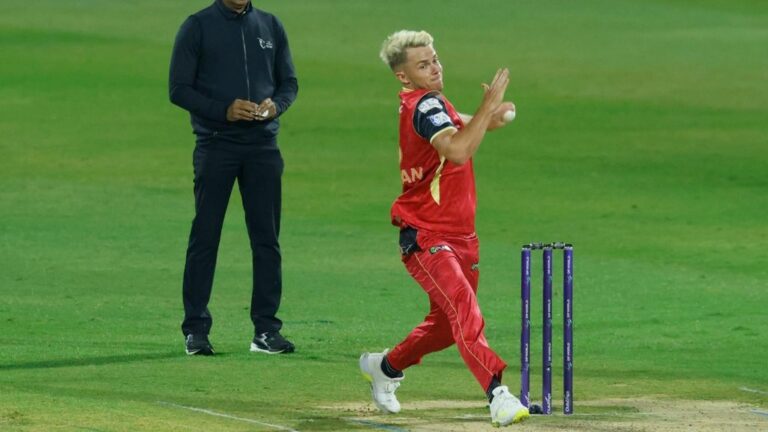
Dubai, UAE (October 15, 2024)- All-rounder Sam Curran, the player of the tournament in England’s ICC T20 World Cup success in Australia in 2022, will return to the Desert Vipers squad for the upcoming season three of the DP World ILT20.Curran joined the Vipers for two matches at the end of last season and the signing of such a high-quality performer is a signal of the desire of the franchise to return to the sort of form it showed in the first edition of the DP World ILT20 when it finished as runner-up.In welcoming back the player, Desert Vipers Director of Cricket Tom Moody said he believed Curran’s presence for a longer period following his season two cameo would benefit not only the Vipers but also the entire tournament.“We are obviously the recipients of a high-quality player, and it is great that he feels the Desert Vipers is a home for him where he can apply his trade and hopefully help us achieve what we are looking to achieve as a franchise,” said Moody.“One of the positive things for the Desert Vipers and the tournament itself is that Sam has decided to come to this league against the other options that are out there. I think that says a lot about how the competition is held in players’ eyes and the growth of the tournament moving forward.”Curran brings with him a wealth of international experience and is the third-highest wicket taker for England in Twenty20 Internationals over the past two years.The all-rounder, who is still only 26 years of age, made his international debut in a Test match against Pakistan in 2018 and has already amassed 1574 runs and 134 wickets for his country across formats.Curran has also made a name for himself plying his trade in shortform tournaments across the world, be it in India, South Africa or back home in England. His most recent outing in the Indian Premier League saw him taking over captaincy duties for the Punjab Kings after skipper Shikhar Dhawan was ruled out due to injury.Curran ended that tournament as the franchise’s fourth-highest run-scorer (his 270 runs including two half-centuries and coming at a strike-rate of 123 runs per hundred balls) and its third-highest wicket-taker (with 16 wickets in 13 matches).Tom Moody said that while no decision had yet been taken on who would assume the captaincy following the departure of Colin Munro, he expected Curran to play a key part within the Desert Vipers think-tank for the upcoming season.“With regards to his captaincy experience and what he has done in the IPL with the Punjab Kings and what he has done elsewhere, he will play an important leadership role within the group,” said Moody.“He has got a huge amount of experience in this format of the game and can offer a lot. The thing that he just brings naturally is that he is an instinctive leader. So we will all lean on that experience, and he is willing to be an important voice as the tournament unfolds.”The signing of an all-rounder is something that may raise some eyebrows given the continuation of the impact substitute rule for a second season in the DP World ILT20, with the expectation that sides will pack their line-ups with specialist batters and bowlers at the expense of players who offer both skills.The rule allows teams to replace a player at any point during a match, with the trend towards a bowler replacing a batter or vice-versa once the incumbent’s primary role in the side has been carried out.Moody said he knew Curran’s strengths well having worked with the left-hander at the Oval Invincibles, the team that has won back-to-back titles in England’s short format tournament, The Hundred.And the man who was also an ICC Cricket World Cup winner with Australia in 1999, said he was certain Curran could play an influential role in the upcoming campaign.“I have had a lot to do with Sam over the past few years with the Oval Invincibles, so having that personal connection goes a long way in knowing exactly what he can deliver both on and off the field,” said Moody.“And while people probably ask why an all-rounder when there is the impact sub rule, well, Sam Curran is one of those unique all-rounders that plays a complete all-round game, and what I mean by that is that he can take the new ball, he can bowl effectively in the middle overs and he is well-versed when it comes to bowling at the death which is such a critical component when it comes to any team.“With the bat he is versatile as he can fit in anywhere from one to seven and can be very effective in all those roles. And finally, being a left-hander, it just adds an extra dimension in his role in the side where we can move him up and down the batting order according to the situation.”The schedule for season three of the DP World ILT20 is expected to be announced soon and ahead of that announcement all teams, not just the Desert Vipers, are firming up their final UAE player selections through the ongoing DP World ILT20 Development tournament in Dubai.Looking ahead to season three, Tom Moody said he was satisfied with all the recruits and retentions confirmed so far.“Our preparation for season three began months ago with regards to recruitment and finding the right balance for the squad and player availability for the January – February window and we are very happy with the recruiting process and who we have on board.“We are very excited to be competing in season three in 2025, with some familiar faces and also some new faces to represent the Desert Vipers,” he added.Incomings include explosive Pakistan top-order batter Fakhar Zaman, ex-England under-19 captain Max Holden, England seam bowler David Payne who was part of the Gloucestershire side that won the T20 Blast in England and Wales in 2024, and New Zealand speedster Lockie Ferguson.They join a dressing room that already features players including star all-rounder Wanindu Hasaranga from Sri Lanka, Pakistan left-armer Mohammad Amir and wicketkeeper-batter Azam Khan, plus Alex Hales, the man who was the leading run-scorer and maker of the tournament’s first hundred in season one.And the UAE players already locked in are outstanding young all-rounder Ali Naseer and talented wicketkeeper-batter Tanish Suri.

The Desert Vipers and PALMFIT Lead Environmental Consciousness in Sports Apparel

0

In an innovative three-year collaboration designed to drive positive, sustainable change in cricket apparel and beyond, ILT20 cricket team, theDesert Vipers, has partnered withPALMFIT, a UAE-based sports apparel manufacturer, to create a line of performance wear, team wear and leisurewear made entirely from recycled materials.

The announcement is the latest in a series of initiatives undertaken by the Desert Vipers to reduce their own impact on the environment and to create a community in sustainability in sport.

This range incorporates recycledpolyester and cotton, reducing carbon emissions by approximately 50% compared to virgin materials. The sustainability benefits extend beyond material use, with local production reducing emissions from the shipping of kit, bio-based inks being used for printing, and print-on-demand methods reducing fabric waste.

PALMFIT kit will be worn for the first time by a Desert Vipers cricket team for the ILT20 Development League which starts on 6thOctober at the ICC Academy, where players will wear the ILT20 2025 1stteam training kit. The Desert Vipers and PalmFit will unveil the ILT20 2025 1stteam playing kit in front of the sports industry at the Dubai Sustainability in Sport Conference on 6thNovember.

The range of performance wear, teamwear and leisurewear, “The Viper Line” by PalmFit, sets a new benchmark for sustainable sportswear in the United Arab Emirates. As well as championing “Made in UAE”, now all sports organisations of any type from grassroots to professional level will be able to select high-performance sports apparel that is less damaging to the environment in its manufacture.

For instance, theArabian Desert Camel Riding Clubhas already chosen to outfit its female jockeys in the Vipers Line by PALMFIT, showcasing how sports organisations across the region are increasingly adopting sustainable solutions.

Matt Bailey, Head of Strategy for the Desert Vipers, said:“By partnering with PALMFIT, a UAE-based business, for the 2025 ILT20 season, choosing recycled materials and incorporating their specialist sports expertise in design, we will reduce our carbon footprint emissions associated with kit production by50%compared to last year. Moreover, by choosing the “Vipers Line” from PALMFIT, our colleagues in the sports industry in the UAE and beyond can now do the same. It is important to recognise that we are simply creating a baseline with PALMFIT this year in the choices that we have made and we have a lot of work to do. That is tremendously exciting for the Desert Vipers as we look to be “part of the solution” to some of the greatest challenges that sport faces, such as climate change and plastic pollution”.

Hanish Bhatt, Founder and Director of PalmFit, added: ‘’This collaborationrepresents a significant milestone for us, as it aligns with our mission to deliverperformance-driven activewear while championing sustainability’. At PALMFIT, webelieve that the future of apparel lies in minimizing our environmental footprint, whichis why we’ve integrated on-demand production and eco-friendly materials into ourdesigns. Partnering with the Desert Vipers allows us to showcase how high-performance sportswear can be both functional and environmentally responsible,ensuring athletes can perform at their best while supporting a sustainable future.’’

This partnership is just the beginning. While the global sports industry has been slow to address sustainability in kit production, the Desert Vipers and PALMFIT are committed to committed tocontinuous innovation, exploring new materials, and implementingcircular solutionsto make a lasting impact on both the environment and the sporting world.

Inaugural Dubai Sustainability in Sport Conference to Advance Dubai’s Sports Sustainability Agenda

0

In partnership with the Dubai Sports Council, ILT20 cricket team, the Desert Vipers, are proud to announce the inaugural Dubai Sustainability in Sport Conference, set to take place on November 6th at the SEE Institute, Sustainable City Dubai.

This groundbreaking event aims to bring together key UAE sports entities to advance the agenda for sustainability in sport.

Owned by Lancer Capital, the Desert Vipers are one of six teams competing in the ILT20 tournament in the UAE.

As pioneers in sustainability, the Vipers lead by example in eco-conscious operations and carbon footprint transparency, setting a new benchmark for global sports teams across the world.

As part of its 2024-2033 strategic plan for the sports sector, the Dubai Sports Council is dedicated to enhancing sustainability in sports. The Council’s focus on integrating sustainability applications in sports stadiums and tournaments through awareness campaigns and practical applications will ensure that both the environment and sports are safeguarded for the future.

The conference, designed in collaboration with the Desert Vipers, will serve as a launchpad for this initiative.

The invitation-only conference will become an annual gathering, hosted by the Desert Vipers and the Dubai Sports Council, reinforcing their commitment to sustainable sports practices.

The summit’s agenda will focus on the Council’s key sustainability themes:

*Environment *Community *Economic

Phil Oliver, CEO of the Desert Vipers, commented, “The Sustainability in Sport conference is an essential platform for fostering collaboration and innovation in sustainable practices within the sports industry. By bringing together key stakeholders, we aim to create actionable strategies that will benefit both the environment and the sports community.”

His Excellency Saeed Hareb, Secretary General of Dubai Sports Council was thrilled with the prospects embodied in the organization of such an event.

“This sort of sustainable initiatives tie up so well with our goals at the Dubai Government and the Dubai Sports Council. An event like this will bear fruit for future generations in the long term,” HE Saeed Hareb said.“At the DSC, we are fortunate to have such a vibrant leadership that will always help us to set goals and pursue these in proper alignment with the Government’s purpose. We are confident of playing an ambitious role over the next few years to achieve the goals set,” he added.

Dignitaries and athletes who support sustainability in sports will be present at the event being held at the SEE Institute, a pioneering sustainability institute located in Sustainable City Dubai.

The institute serves as a hub for sustainability education, research, and implementation.

The Desert Vipers would like to acknowledge and thank the Sports Spirit Federation (SSF) for facilitating this vital relationship. Their hard work and diligence have been instrumental in ensuring that this partnership will enhance the work being done in the region, making it even more impactful.

With their extensive experience in the sports sector within the UAE, SSF’s involvement has been crucial in fostering a partnership that promises to deliver significant benefits.

How We Measure Our Off-field Work

0

Why We Measure

One of the main reasons that we do this is because of our commitment to theUnited Nations Sports for Climate Action Framework. This framework commits us to Net Zero by 2040 and halving our emissions by 2030, as well as reporting annually on our footprint and using our platform as a vehicle to spread positive environmental change.

In Season One of ILT20, Desert Vipers collected and recorded their footprint for the vast majority of their activities. However, for Season Two, we have undertaken a lot more activities, such as the inaugural Viper Cup, for which we need to collect and record more data and with an increasing level of accuracy. I (Ben Hardy-Jones) have been leading on this work, but I’ve been helped enormously by several members of the team, including Danielle Clarkson, our Office Manager, and you can read more about her perspective on this inlast time’s blog.

Many sports clubs are still yet to make it a common practice to collect and report publicly on their environmental footprint and so for us, one of the challenges is to understand how our footprint compares to others, and to see where are the areas where we are above or below the average value. For example in cricket, it is very normal to fly players from place to place (as the seasons move from location to location with the seasons), but what is the average footprint for a club when it comes to this? Are we better or worse? Are we making a positive difference in this space? However, no such numbers are publicly available, and as of now, we are a lone wolf in cricket when it comes to transparently sharing our impact.

The Global Sustainability Benchmark in Sports (GSBS)

Therefore, we need to think differently about how we can compare ourselves to others and push ourselves to continue to lead the charge in a way that brings people and the planet together. One of the ways that we are doing this this season is through the Global Sustainability Benchmark in Sports (GSBS). The GSBS is a platform and a tool in which to measure ourselves across a range of areas, such as environmental, social, governance, and commercial. Last year‘s report featured many different teams across a multitude of sports and global regions; however, to date there have been no entries from cricket, nor the Middle East. For this reason, we have signed up to the GSBS to advance the sustainability agenda for cricket and get it on the scoreboard, as well as for the Middle East.

One other reason that we have signed up to the GSBS is to ensure that we can look at how we are doing across other sports and regions – typically those who have historically focussed on sustainability much more than cricket and the Middle East have to date. This will do one of two things. Firstly it will allow us to compare ourselves to sports who are best in class across the world. Secondly, it will give us a platform to advance more positive change in the Middle East as we are showing that anyone can do it, no matter what region they are from, and so hopefully others will follow where we lead.

The Gulf Sustainability Awards

Closer to home now, and one of the ways in which we are evaluating and showcasing our initiatives is through the Gulf Sustainability Awards. These awards cover a range topics which are suitable for a range of businesses and industries. This year, Desert Vipers have entered the Best Learning and Educational Programme Award. We have entered our School Sustainability & Coaching Programme for this award as we believe that it is an innovative and positive programme that promotes and educates around sustainability across schools in the UAE. You can hear more about the school programme on this episode ofVipers Voices.

We submitted our application for this award a few weeks ago, and we are now pleased to share that we have been shortlisted for the final! This will be held in September. We hope that we can go all the way and win the award; however, there are some other very strong candidates which is fantastic to see, showing that sustainability is clearly advancing in the region, and we are part of that movement. Regardless of if we winor not, we have proven that sports teams can address sustainability issues in a positive and proactive way and efforts are valued highly within the sports community and the wider Gulf region. This gives us the impetus to continue to expand and improve on the programme, which we are doing next year, aiming to reach 40 schools (building on 25 last year), which is made possible through the employment of cricket’s only full-time Development Lead in the UAE, Jack Luffman. If you or anyone you know from schools in the UAE would like to get involved in our programme, please get in contact with us atjack@thedesertvipers.com!

Sustainability Spotlight – Gulf Sustainability Awards

This week we shine a light on theGulf Sustainability Awards(GSA). The GSA is on a mission to recognise, reward, and promote outstanding sustainability initiatives across the Middle East. Many businesses will embrace sustainability practices over the coming years, so these awards are crucial to seeing where businesses stand when it comes to sustainability. Providing a platform to view the advancements in sustainability across a range of sectors and businesses is invaluable when trying to learn from the best in the business, so the fact that the GSA provides the opportunity to hear first-hand from others at the final is fantastic. We hope to win, of course, but we wish every other entrant the best of luck, and we are excited to hear more about the initiatives undertaken by so many others at the final in September!

How Sustainability Affects Our Staff: An Insight From Our Office Manager

This blog is a little different than usual, as we have given the opportunity to our Office Manager, Danielle Clarkson, to talk about what Desert Vipers’ sustainability journey means to her, and how it affects her day-to-day role. We hope you enjoy this different perspective!

As the Office Manager of the Desert Vipers, I am honoured to share the profound impact that our mission, to prioritise sustainability within the organisation and achieve net zero by 2040, has had on me personally – as well as its significance for the long-term future of our beloved sport.

Personal Journey and Commitment to Sustainability

When I joined the team for our inaugural ILT20 season, I knew sustainability was central to our identity. It felt wonderful to find a role that aligned with my values. As a mother of three young girls, I had previously explored business ideas like selling recycled swimwear made from plastic bottles and other initiatives to positively impact the planet for future generations. So, when this opportunity arose, I knew it was the perfect fit and it was one of the reasons I applied for the role!

One of the key takeaways from my time with the team so far has been an appreciation of the magnitude of changes needed from the usual way of doing things to reach sustainability goals, which I learnt about through our internal training and discussions with sustainability partners. This journey has been truly eye-opening.

Reflecting on my past roles, where I routinely ordered thousands of plastic water bottles, witnessed daily office food waste, and booked countless unnecessary business class flights, I realise how unaware I was about the consequences of these actions, and the culture of the organisations meant potential changes to the status quo were not explored.

In contrast, learning about sustainability through team training has underscored the value of our sustainability actions and partnerships at Desert Vipers, such as with Bluewater, who have helped us to eliminate all single-use plastic water bottles from our team environment on and off the pitch. Our use of reusable bottles, supported by our forward-thinking team, players, and coaches, became a hot topic for commentators and media coverage in Season 2!

Learning About Climate Change and Resource Management

We are all aware of the recent heavy UAE storms, which caused serious flooding to roads and homes, damaged cars, forced the closure of schools and offices, and shut down public transport systems. Having personally been affected by the storms and hearing of the devastation caused across the country, this further sparked my desire to learn about climate change and the adverse effects it has on our weather and planet. With the support of the team, I have started an online course specifically for sustainability professionals and I am now currently learning about the science of climate change!

One module, ‘Life Cycle Assessment’ (LCA), has been particularly enlightening. LCA is a systematic approach to evaluating the environmental impacts associated with all stages of a product’s life, from raw material extraction through to manufacturing, distribution, use, and disposal. This course has deepened my understanding of the intricate details of the supply chain and the long-term environmental effects of each product we use. It has taught me the significance of choosing recycled garments and responsibly sourced materials over cheaper, less sustainable options. At Desert Vipers, our understanding of the lifecycle of products and using our own “Sustainable Sourcing Code” based on a set of six key questions, influences the decision we make when it comes to purchasing materials, helping us to minimise our overall environmental footprint.

Last season, it was a wonderful experience working alongside the management team to convey our message to fans and sustainability-focused businesses, with the highlight being our first dedicated ‘Sustainability Match’. Post-tournament, my role involves gathering supplier information, such as flights taken, hotel bookings, and other data required to track our carbon footprint. We can already see from tracking Seasons 1 and 2 that our efforts are making a tangible difference, and we can clearly see the areas that we need to focus on and improve on to reach our net zero goals. With continued learning, exciting projects on the horizon, and looking ahead to Season 3, I feel honoured to be part of this team, leading and influencing others in the sports industry and beyond to make positive changes.

Regardless of your position, from CEO to Office Manager, we can all take steps now. Whether it is deciding to offer your employees internal training or remembering to use your reusable water bottle (we all have them!), it is time for all of us to play our part.

Sustainability Spotlight – The Plastic Pledge

This week we shine a spotlight onThe Plastic Pledge, an organisation in the UAE who are raising awareness about the impacts of plastic waste and mobilising people to take action. Desert Vipers have a partnership with The Plastic Pledge, and we are proud to be partnered with an organisation who is inspiring change across the UAE and beyond.

One of the main ways that The Plastic Pledge have raised awareness about plastic pollution is through their mammoth rowing journeys. In December 2022, Toby Gregory – founder of The Plastic Pledge — embarked on the challenge of a lifetime. He rowed 5,000 km, unsupported and unassisted, across the Atlantic Ocean. Toby used the publicity from the crossing to raise awareness about environmental sustainability and the fight against plastic pollution. Toby and his team are about to embark on another impressive journey: rowing to the Arctic. We at the Desert Vipers would like to wish him and his team the very best of luck on this journey, and look forward to following his progress online! Good luck!

Our Sustainability Match Report

0

For World Environment Day on 5th June, we released ourSustainability Match Report. This report draws together everything we did on our momentous first ever Sustainability Match on the 3rd February vs Gulf Giants. This blog is separated into four sections. It starts with some of the highlights from the match. It then explains the (often painstaking) process of collecting data. Some comparisons with other events and teams is then provided, before finishing by explaining what comes next for Desert Vipers.

Our Sustainability Match Report highlights

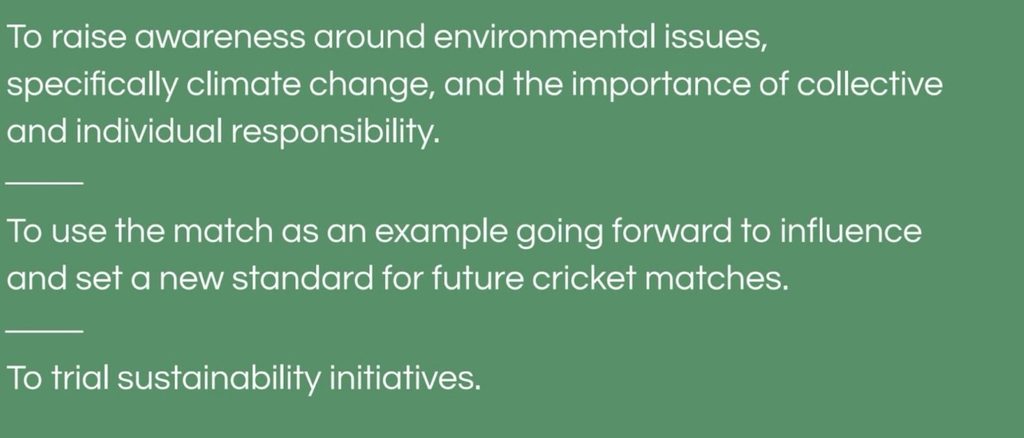
The Sustainability Match had three main objectives:

In many ways, the match was used as a celebration of the start of our sustainability journey. In quite a short space of time, we have achieved a great deal with sustainability, although there is so much more to come. This match was intended to celebrate our commitment to people and the planet, and to raise excitement around the topic of sustainability and the opportunities it can bring.

While we have already accomplished some notable achievements when it comes to sustainability, such as eradicating single-use plastic water bottles from our team environment, both sports and sustainability are about incremental gains and striving for more. For this reason, we wanted to use our Sustainability Match to trial some new initiatives, and set a new standard for future cricket matches. One of these initiatives was to place plastic recycling bins in the stadium for the first time ever. In total, we placed 20 bins in the stadium, and collected 55 kg of plastic for recycling. These plastic bottles will be turned into sports apparel, creating a circular loop. Another initiative was to place carbon footprint labels on menus in hospitality areas, which we believe might have been a first in sports?! My background from my Masters Degree was studying the carbon footprint of independent restaurants, so this was something that was close to my heart. It was fascinating to see the different carbon footprints of dishes, and, while only an approximate value, it provided some interesting discussion amongst attendees.

How we collected data

One of the outcomes of the event was that we produced a carbon footprint report specifically for the match. For this, we required a variety of different information sources.

Firstly, we wanted to understand the footprint of fan travel. For this, we created surveys where we asked fans:

The results of the survey were very interesting, as shown in the table below:

Transport Type

Journey Duration

No. of People Accounted For

% of Fans

Total No. of Fans

No. of Vehicles

Speed of Travel (km/h)

Return Distance (km)

Total Distance (km)

Bus

16-30 mins

60

9.7%

775

16

60

46

736

31-60 mins

460

74.3%

5945

119

60

90

10710

60+ mins

54

8.7%

698

14

60

150

2100

Total

574

92.7%

7418

149

13546

Car

1-15 mins

29

4.7%

375

125

70

19

2375

16-30 mins

8

1.3%

103

35

73

56

1960

31-60 mins

0

0.0%

0

0

76

117

0

60+ mins

0

0.0%

0

0

80

187

0

Total

37

6.0%

478

160

4335

Taxi

1-15 mins

2

0.3%

26

9

70

19

171

16-30 mins

4

0.6%

52

18

73

56

1008

31-60 mins

0

0.0%

0

0

76

117

0

60+ mins

0

0.0%

0

0

80

187

0

Total

6

1.0%

78

27

0

Metro

1-15 mins

4

0.6%

52

N/A

42

11

569

16-30 mins

0

0.0%

0

N/A

42

32

0

31-60 mins

0

0.0%

0

N/A

42

64

0

60+ mins

0

0.0%

0

N/A

42

98

0

Total

4

0.6%

52

N/A

569

The next thing we wanted to understand was our team’s impact on our footprint. For this, we calculated the emissions from the team coach, by recording the distance from the team hotel to the stadium, the fuel type, and the average fuel consumption. The other thing the team controls is our fan giveaways. We recorded the number of items given away, the average weight, the material composition, where it was produced, and what it was packaged in. These areas were under our control so we had a great deal of confidence in their measurement.

The final area which contributed to our footprint was from the stadium. There were several different elements to this, which had a varying degree of success in measurement. On the more successful side, provision of quantities of food and beverages enabled us to calculate the impact from this area. The stadium management team were also able to provide us with a rough approximation of the amount and type of waste from each match, as they gave me a tour of the waste facilities. However, we were unable to receive information in time regarding stadium electricity, air-con, gas, fertiliser, or generators. This proved quite frustrating, and shows one of the difficulties that franchises have when it comes to measuring their carbon footprint. Since franchise clubs do not own their own venue, implementing sustainability initiatives and collecting information for sustainability assessments can be extremely difficult. Mutual cooperation is needed, and we are going to try everything we can to help bring the stadium with us on our journey, and be as supportive as possible.

How we compare to other teams

Our estimated carbon footprint for the match was 23.1 tonnes of carbon dioxide equivalent (tCO2e). If every match in the ILT20 had this footprint, the tournament would have a footprint of 785 tCO2e! For Desert Vipers’ five home matches, we would have a footprint of 116 tCO2e. However, we know that our measured footprint in Season 1, including flights (which made up 70% of our footprint), was 573 tCO2. Therefore, if each of the other five teams had a similar footprint, the total tournament footprint would be 3,437 tCO2e from the teams, plus the footprint from the League management. This is a much higher number than the aforementioned 785 tCO2e, underscoring the importance of measuring not just the matches themselves, but also the activity in the build up and aftermath of the tournament, particularly flights. While it might not make sense to attribute the emissions from the teams’ flights from tournament to tournament or team hotels to an individual match, we must not ignore this source of emissions, as its inclusion (or lack of) can greatly skew the overall footprint value.

Our footprint of 23.1 tCO2e is actually very low compared to other cricket matches! For example, Edgbaston’s GoGreen game had a footprint of 327.8 tCO2e. 270 tCO2e of this figure was from fan travel, whereas our fan travel footprint was just 2.1 tCO2e. The key difference between these figures is that 93% of our fans came on buses (which were usually 50-seaters, so had a low footprint per passenger) for our match, whereas Edgbaston’s information says that they only had 6% of fans coming by bus. In football, a match in 2021 for Tottenham vs Chelsea Men, in the Premier League, was calculated as having a footprint of 862 tCO2e. Again, the majority (93%) of emissions came from fan travel. It’s clear though that reporting on the footprint of individual matches is still in its infancy, and the work that we are doing to be transparent and informative around this is helping to move the conversation forward.

What next?

Preparations for Season 3 are in full swing, with plans for Season 3’s Sustainability Match already underway. We hope to expand our successful trials from Season 2 to every game in Season 3 (we have already asked the League to put plastic recycling in all venues at all matches next year). We’re on the lookout for new initiatives to trial next season, so if you have a suggestion, please email us atsustainability@thedesertvipers.com. We hope to see you at our Sustainability Match in Season 3!

Sustainability Spotlight – Bluewater

This week’s Sustainability Spotlight focusses onBluewater, our Official Hydration Partner. Bluewater are a world-leading purified water and beverage industry innovator, who are providing solutions to address the widespread issues across the nexus of water and plastic pollution. In Season 2, they provided state-of-the-art water filtration units to Desert Vipers, and thermally-insulated water bottles for all players and staff, to help us in achieving our goal of eradicating single-use plastic water bottles from our team environment. They were a key feature of our Sustainability Match, as our captain, Colin Munro, handed over a ceremonial Bluewater bottle to the captain of the Gulf Giants, to signify our commitment to bringing people along with us on our sustainability journey. We hope to see many more Bluewater units next to the dugout of cricket pitches in the future, and hope it soon becomes the norm, rather than the exception.

Our Zero Kit to Landfill Strategy

Last year, we launched ourSustainability Strategy Framework, which set out the first steps that we would take towards our aim of becoming the most sustainably run cricket franchise. This guiding document has allowed us to make huge strides within a relatively short period of time with regards to sustainability. For example, our ‘Introduction to Cricket’ Schools Outreach Programme, led by Jack Luffman (Community Engagement Manager), which combines education on basic sustainability themes with cricket coaching, has already been a huge success within Dubai, and is expanding further this year. On the pitch, our elimination of single-use plastic water bottles from our team environment was another great success, and made a positive material impact immediately, saving 14,400 single-use plastic bottles from being used during the season.

In Season 3, while we will continually strive to reduce the environmental impact from all areas of our operations, our focus will predominantly be on apparel. Sports kit is an area of the sporting industry with an enormous environmental impact,which you can read all about in the last blog. Moreover, it is one of only a few areas where we have direct control, so we can make an impact immediately.

Progress to Date

One thing we have already done in Season 2 is operate without sending any kit to landfill. While this may seem a rather simple thing to be able to do, and not a very difficult claim, it is actually not common practice for sports organisations to have policies in place to achieve this. For example, British Cycling recently signed a new (controversial) sponsorship deal with Shell. This meant that their old kit, with HSBC as the sponsor, was not able to be worn. Instead of donating this kit to local cycling charities, upcycling it, or recycling it, the clothing found its way into the skip to be sent for landfill. These kits cost thousands of pounds, and have a huge environmental footprint in their production, so ending up in a bin destined for landfill is the worst possible outcome. This problem is not unique to British Cycling: with the constant changing of sponsors, and new kits being produced every year, the potential for waste is high, and so having policies in place is essential to eliminate waste and ensure no kit gets sent to landfill.

At Desert Vipers, our Zero Kit to Landfill Strategy is a continuation of our work to embed sustainability within the heart of our operations as a franchise. This reflects all four of our values: High Performance (donating quality kit to those in need will allow them to strive for their own dreams of being the best cricketer they can); Innovation (this strategy is uncommon in global sports); Sustainability (reducing the amount of kit from landfill has numerous environmental benefits); and Social (aside from the obvious benefit of providing quality kit to those in need, a Zero Kit to Landfill Strategy will create jobs through its upcycling and recycling partners, and encourage positive societal change).

In Season Two, we generated approximately 6.7 tonnes of kit as a franchise, with most of this coming from kit given to fans locally in Dubai on matchdays. In the early stages of our brand-building journey, it is important to continue providing kit for fans to wear because every fan counts, so we do not want to stop distributing kit to fans. However, we want to ensure that this kit does as little environmental harm as possible. We are actively addressing the materials used for the kits and the packaging they come in – more of which will come in due course. But firstly, at the end of the life stage (as we already have some leftover kit from Season 2), we need some solutions.

Our Plan

We will aim to do three things with kit:

1. Donate kit

In the short term, we aim to donate the majority of usable kit to people in need in cricket-playing nations. We will minimise the footprint from transporting donations by prioritising distribution in the UAE first. As time progresses, we aim to donate a lower percentage of kit, as we would like to have systems in place to do other things with it, such as upcycling or recycling.2. Upcycle kit

In the short term, we aim to sample a few different pieces of kit made through upcycling, using local upcycling partners in the UAE where possible. An example of something that we could make would be bucket hats for Season 3 from Season 2’s unused clothes.

3. Recycle kit

In the short term, we aim to identify suitable solutions for recycling kit. For example, it is more difficult to recycle garments made from multiple materials (such as polycotton fabrics), so moving our range towards monofibre materials should make recycling easier, and might be a step we take. As kit reaches the end of its life in several years, this will become more important as a step, but the design considerations need to commence sooner, so that when the kit does reach its end of life, it hasn’t been designed in a way that makes it impossible to recycle.

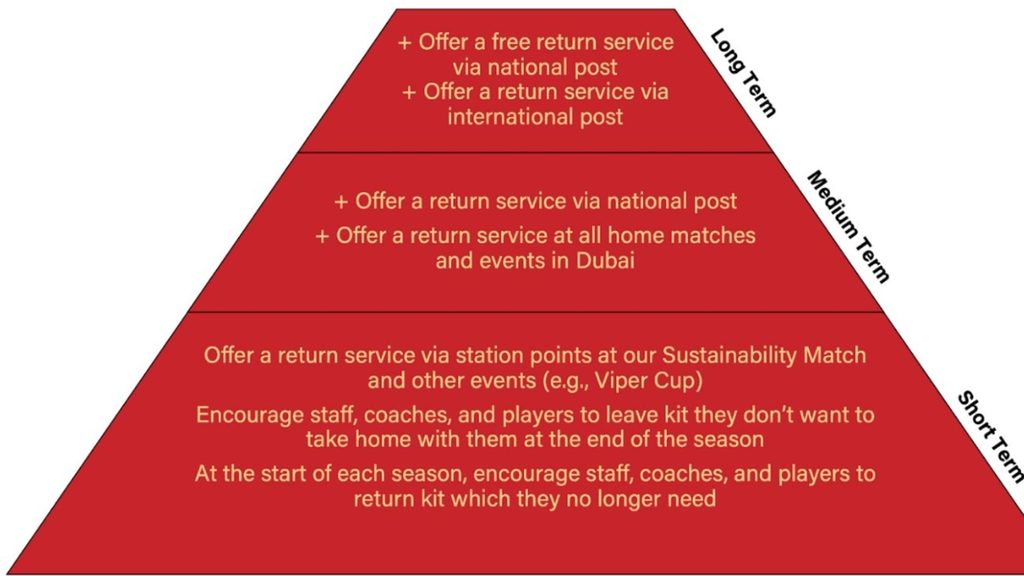
Finally, one of the difficulties in ensuring no kit goes to landfill is receiving the kit at the end of its use phase. There are several ways to do this, such as through offering a return service at matches, or via post. The diagram below shows one possible solution for encouraging the return of kit after it is no longer wanted:

Without the fans on board and providing solutions for them, achieving zero kit to landfill won’t be possible, so we hope that fans are excited to be part of this journey with us.

Sustainability Spotlight – Bat For A Chance

This week’s blog has focussed on our Zero Kit to Landfill Strategy, so it seems only fitting to focus on one of ourSustainability Impact Partners, Bat For A Chance (BFAC), who have helped us ensure that none of our Season 2 kit has gone to landfill.BFACaims to help the underprivileged experience the joy of cricket, through distributing kit to those in need. Since their inception, they have provided access to cricket for over 15,000 men, women, and children, across four continents and 21 countries. We are proud to partner with such an amazing organisation, and we look forward to continuing to work together on our mission to ensure zero kit gets sent to landfill.

A Deep Dive Into the World of Sports Apparel: Its Environmental Issues & Solutions

0

What’s the problem?

The fashion industry is responsible for 8-10% of global emissions (more than aviation and shipping combined). This high figure is due to its use of raw materials. For example, around 340 million barrels of oil are used per year to produce polyester. The energy needed for the production processes also contributes to the high emissions figure (and this isn’t even considering the 43 million tonnes of chemicals used per year for this). Fashion is also a big user of land; for example, cotton growing uses about 2.5% of the world’s farmland. It’s therefore safe to say that fashion has a huge problem. It may be surprising to some readers to consider sports apparel as items of fashion, but increasingly people are choosing to wear sports apparel, even if they’re not doing sports. With sponsors changing annually, and new designs released and promoted each season, sports apparel falls under the category of fast fashion. Sports clothing also consists of (mainly) virgin polyester, which has a huge negative impact on the environment, from emissions released during its production, to microplastic shedded during the washing of garments, to what happens as the end-of-life, usually ending up in landfill. There’s therefore two main issues with sports apparel: over-consumption & production; and the actual materials used in the garments.

The impact of Desert Vipers’ sportswear on the environment

Our carbon footprint for Season One was roughly570 tonnes CO2e. Sports kit was the 2nd largest contributor to this, behind only air travel, and accounted for about 8% of our total footprint. Considering plastic, sports kit is the biggest contributor by some margin to our plastic footprint, accounting for around 85% of our plastic footprint in Season Two (our plastic footprint report is forthcoming), although our efforts to successfully eradicate single-use plastic water bottles from our team environment has slightly increased the share of plastic that sports kit contributes to. In total, our plastic footprint from sports kit in Season Two was over 3,000 kg! We are yet to calculate our water footprint or biodiversity impacts, but sports kit will be a great contributor to both, so the impact of sportswear on the environment within our own organisation’s context is significant.

Sportswear Pro Conference and Exhibition

In order to learn more about the industry and how we can play our part in fostering sustainable choices, Matt Bailey and I (Ben Hardy-Jones) recently attended the Sportswear Pro Conference and Exhibition in Amsterdam. The exhibition featured all corners in the industry, from material producers, to manufacturers of the latest machines (including those using AI technology), to print professionals, and more. It was fascinating to speak to different professionals and understand how the whole supply chain worked, and to start to piece together which places we could intervene to make our own purchases more sustainable.

The Conference itself was highly informative and thought-provoking. The day started with an interesting discussion from Samantha Taylor, Ana Kristiansson, and Lucy Maguire around sportswear trends. Personalisation was heavily emphasised, driven by influencers. Currently in the sports industry, personalisation solely consists of putting a name and number on the back of a shirt. However, it was intriguing to consider other methods of (non-material) personalisation, such as putting content like NFCs into garments, so that items can be sold or donated after the owner no longer wants them. The other trend in the sportswear industry is related to sustainability, and in Europe, is primarily being driven by upcoming EU sustainability regulation. This was explained thoroughly later in the day by Katarzyna KlaraSulisz, from the Federation of the European Sporting Goods Industry (FESI), who spoke about five different upcoming regulations. While Desert Vipers are not based in Europe, this regulation may affect our suppliers who are based in the EU, and when it comes to sustainability, the EU are usually leading the way with regulation, so it was important to understand this regulatory landscape.

Following the first discussion were two talks from a scientific perspective, focussing on the material properties of garments. First was from Paul Foulkes-Arellano. Paul spoke about the fascinating work being done in improving materials for sportswear, with many start-ups using agricultural waste to produce clothing. He emphasised how not all agricultural waste sources are equal in terms of sustainability; for example, potato waste is poisonous and currently only goes into landfill, so is a better option for sportswear than corn waste, which can be used for other purposes. Nicole Espey from RWTH Aachen University then highlighted some of the challenges from a scientific point of view, and talked about biomaterials.

Another theme at the conference was around circularity and the circular economy, and how this could contribute to more sustainable sports apparel. Being a student of Kate Raworth, circular economy guru, it was brilliant to hear her ideas being spoken about and practised by those in the sportswear industry. In particular, it was captivating to hear from Ana Kristiansson about 20 principles for designing for circularity, and great to hear from Serena Bonomi, Luna Aslan, and Joanna Czutkowna about how to close the loop & recycle or reuse the product at the end-of-life. Overall, it rounded off the event perfectly, and drew together multiple ideas which have given Matt and me plenty of (low-carbon) food for thought.

Solutions – For the Industry

The Sportswear Pro Conference and Exhibition has given us a few ideas about potential solutions to the environmental (and social) issues addressing the fashion industry and the world of sports apparel. Industry-wide, there are three key themes which can drive a more sustainable future:1.Designing for circularity

Designing materials which are intended to be durable, repaired, upcycled, and recycled is a first key step.2. Using more sustainable materials

Products using materials made from waste or recycled materials can dramatically reduce the energy required for production, lowering CO2emissions. Sustainable materials can also reduce the harm caused by the product during the use phase and the end-of-life phase.

3.On-demand printing

Overproduction is a major component of the environmental issues caused by the fashion industry. Making materials on-demand, using the latest technologies (which allows production to occur closer to home – termed ‘near-shoring’ – which reduces the distance goods have to travel) can go a long way to addressing these issues. Personalisation can play a part in this, as long as the personalised elements are modular and so can be removed when the individual would like to sell or donate the product.

Solutions – For Desert Vipers

I think it is fair to say that Matt and I came into the conference seeking an answer to the golden question: “what is the most sustainable option for sportswear?”. We left with more questions than answers, but crucially, we left knowing what were theright questionsto ask. There is no ‘one size fits all solution’, so our original question was misguided. Instead, we realised that each option has its merits and drawbacks, and it is up to the individual organisation to find the best solution for its own circumstances, and to continually improve over time, as technology, supply chains, and best practices evolve.

Our approach for kit going forwards is therefore a holistic one. We have now segregated the different areas of kit procurement and its purposes, allowing us to seek different suppliers and solutions for different needs. We’ve left understanding the industry considerably better, meaning we can suggest sensible solutions to existing suppliers and help bring them on the journey with us, so we can create a ‘just transition’. However, where new suppliers may claim to provide a better solution for a particular area of our kit, we now know the right questions to ask of them, and understand the operational implications much better, ensuring that any solution we implement is truly better for both people and the planet.

If you are a supplier of sustainable sports apparel, please get in touch with us atsustainability@thedesertvipers.com, and we would love to discuss how we can work together to bring proper, meaningful change to an industry in need of reform.

Sustainability Spotlight – Reflo

In a blog all about sustainable sportswear, what better organisation to focus on this week thanReflo, a sustainable sportswear brand who are seeking to address the problems outlined in this blog? Reflo produces excellent clothing which is made from advanced technical fabrics that are woven from recycled waste, such as single-use plastic and coffee beans. Their designs are intended to be futureproof, so they stay relevant for years to come and are durable. What’s more, is that they want to go beyond sustainability, and become aregenerativefashion brand. This means that instead of ‘doing no harm’, they want to go further and actually do good! It is so refreshing to see this approach, particularly in the sportswear industry. Reflo have also just launched their clothing at GO Sport stores in the UAE, so anyone who wants to can head there and check out the brand for themselves!


Looking Towards Season 3

0

Readers oflast week’s blogwill have learnt about our Season 2 highlights. After a successful first season for sustainability, it’s important to evaluate those successes and analyse where we can make improvements in future seasons. This blog will walk you through the processes of what we do to take stock, close off the year, and go again – a theme which every sporting organisation in the world should do!

How we close off the year

In the immediate aftermath of our final match, there was lots to do before everyone left the Team Hotel. The nature of knockout tournaments means that you’re never 100% sure of when you will be out of the competition, so creating systems to simplify the process of packing up and leaving is of paramount importance. This year, we focussed on collecting and recording leftover kit – either that which was earmarked for the fans for the knockout stages (which we didn’t quite reach), or kit which our team members wanted to leave for us to donate or upcycle. This consisted of creating a central location for players, coaches, and staff to leave kit, and communicating this with them. We have now got the leftover kit in our office, ready to distribute to our charity partners and upcycling businesses, and is one tick in the box in terms of closing off Season 2.

Many other things take slightly longer, however, and require persistence. One of the most important things from a sustainability perspective is to gather data for our Season 2 carbon footprint report – a process which we are currently in the middle of. We have been following up with suppliers, partners, and businesses with requests for information for various things pertaining to sustainability. The nature of requests varies depending on the supplier, but all are chased up to ensure that we are collecting everything which forms a part of our carbon footprint!

Once we have collected the data (and some suppliers are much quicker to respond than others, meaning this can take some time), we take the raw data and calculate our carbon footprint using greenhouse gas conversion metrics. As a signatory to theUnited Nations Sports for Climate Action (UN S4CA) Framework, we must submit our baseline footprint calculation to them within 18 months of joining, which is before October 2024 for us. Given that Season 1 was all about setting up the franchise, we will most likely take Season 2 as our baseline, as activities took place throughout the year, and is more representative of how we will operate as a franchise in the future. Therefore, we must have calculated our Season 2 footprint and written it up as a report to the UN by October, giving us plenty to crack on with.

Finally, we forged many fantastic partnerships centred around sustainability during Season 2, such as with the Dubai Sports Council, who became our Lead Sustainability Partner, or with Hertz Al-Futtaim, who became our Sustainable Mobility Partner, and many Sustainability Impact Partners or Sustainability Suppliers. We also started relationships and networking with sustainability professionals from various organisations in the UAE, whom we invited to our Sustainability Match. This makes the period between tournaments an exciting time to cement and expand on those partnerships, and seek new ways to work together with organisations to accelerate decarbonisation and sustainability in sports and the Middle East.

What’s next for Season 3?

The end of the season is a fantastic time to analyse what went well and what can be improved upon for the following season. Undoubtedly the success story of the season with regards to sustainability was the eradication of single-use plastic water bottles from our team environment. We will be looking to expand upon this success in Season 3, but we are also looking at where else to focus our efforts and priorities for the forthcoming season. Should we be targeting team travel on the ground in Dubai? Can we look at changing how we fly to reduce the emissions from that? Or should we focus on working with our partners at our hotel and stadium to reduce the emissions from those sources? The answer for this season is that we will be attempting to reduce emissions from all three of these areas, and many more, but we will pay a particular focus toteam kit.

Sports apparel (and the fashion industry as a whole) is a major source of environmental damage, and in Season 1 it was the 2nd largest source of our emissions, behind air travel. It is also something which we can control to a large extent, as we can choose our suppliers and the type of material which forms our kit. We are currently exploring potential options, but this feels like another area where we can shift the dial in sports and change the game (just like with water in Season 2). Matt Bailey and I (Ben Hardy-Jones) will be off to the Sportswear Pro 2024 Conference this week in Amsterdam to learn about sustainable sportswear options, considering all implications, from performance for the athlete, to environmental, operational, cost, partnership opportunities, and many more areas. If you are at the conference and would like to say hello, let us know!

Finally, off the pitch, we are also expanding our Schools Programme and community engagement, and we now have a dedicated full time member of staff in Jack Luffman (who is also Chairman of the Dubai Wanderers, a local cricket club), who will oversee these aspects. These programmes give us a fantastic opportunity to ensure that the Vipers are a part of the local community, and are a way for us to continue our engagement in the off-season, so we’re incredibly excited to see how we can increase our community engagement in Season 3!

Sustainability Spotlight –Hertz Al-Futtaim

This week’s Sustainability Spotlight focusses on our Sustainable Mobility Partner, Hertz Al-Futtaim. Hertz is the world’s fastest growing car rental franchise, and in the UAE, the Hertz franchise has been top of the class in terms of service, quality, and capacity over the last 21 years. Their Al-Futtaim franchise places significant and on-going investment into the company’s fleet, including electric vehicles (EVs). As part of our partnership, Desert Vipers were provided with an EV for Season 2, in an effort to reduce the emissions from our team travel, and accelerate decarbonisation in the automotive industry in the UAE.

Beyond providing solutions to help with our decarbonisation efforts, Hertz UAE are also supporting our Schools Programme, where we are teaching children cricket, with a sustainability twist. We recently took our programme into the Dubai British School, and to the students from the Heroes of Hope, which wouldn’t have been possible without the support of Hertz UAE. To show what the Programme means to all involved, here is a fantastic quote from Jonathan Houghton, the Director of Sport at British School Emirates Hills : “It was a pleasure to have the coaching team from the Desert Vipers working with our students here at Dubai British School Emirates Hills. It was fantastic to see the pupils focused, engaged, and challenged by the skills, drills, and game play that they experienced”. Bravo!