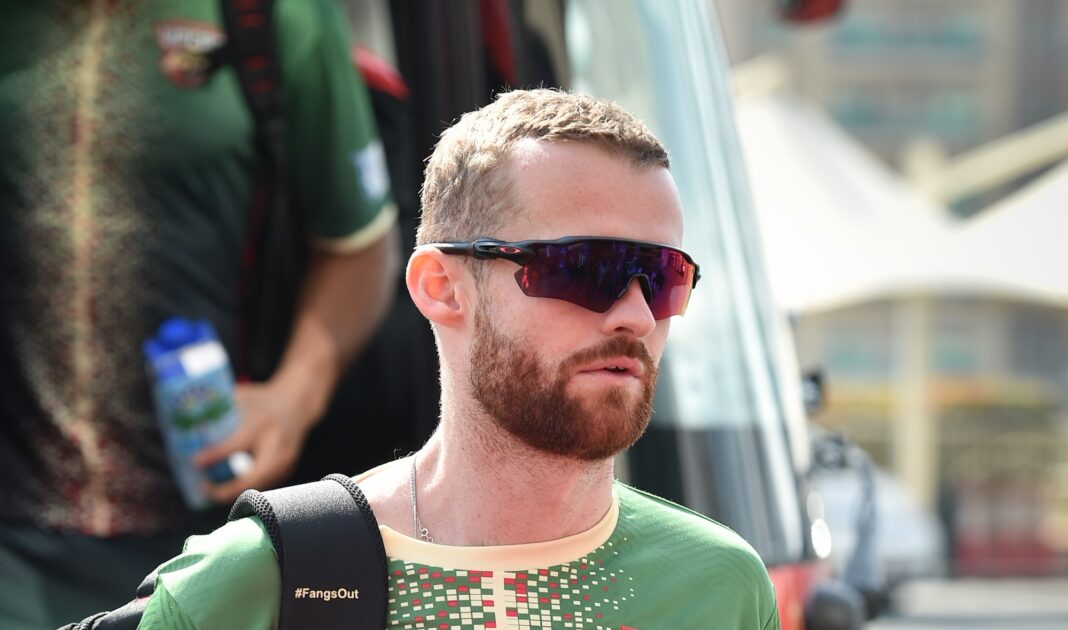
The Desert Vipers have a secret weapon in their armoury, someone who does not bowl a ball, or spend a single second at the crease, and yet is central to the team’s performance and success.
Freddie Wilde is one of the best regarded analysts in the world, and he has been a part of the Desert Vipers cricket set-up since Season 1 of the DP World ILT20. His inputs have played a significant role in helping the franchise reach two of the three finals of the tournament so far.
Speaking to the Vipers Voices podcast the Head Analyst, who has also played a similar role for the England men’s white ball team, the Oval Invincibles and the Royal Challengers Bengaluru in the Indian Premier League, lifted the veil on the role of an analyst in a team.
And Freddie said it was no longer about recording every ball or preparing video clips for the players.
“Generally now, the data is collected for you so I do not have to sit there and code the match. My job is to analyse the data that will then help in preparation for players.
“It could be helping our own players get better, what you can do to sort of stifle the opposition and sometimes it is fairly basic things like providing footage to a player of their bowling from a game.
“Other times it is slightly more complicated, like coming up with plans and then, more recently, there have obviously been auctions and drafts.”
“I have known our CEO Phil Oliver for a long time, and I have known Tom Moody from The Hundred as I worked with him at the Oval Invincibles.
“So, when they got involved at the Vipers, I was one of the early people they spoke to and I have been involved in helping to build the squads throughout all four seasons.
“This is actually the first season I am doing in full on site. I have done some work for the franchise remotely, as my other roles with other teams have often meant I was not able to be here, but this year I am and I am loving it.
“My work really starts with player recruitment, talking to Moods (Director of Cricket Tom Moody) and Fozzy (Head Coach James Foster) primarily about who we should retain from our previous squad or, if we are starting very much from scratch, who we want to sign.
“So, it begins at that recruitment stage and goes all the way through until after the season when I would probably complete a review and then there might be a few months of quiet downtime in between the two seasons before you get back stuck into it when you know retentions and the auction comes around again.”
In October the DP World ILT20 held its first ever player auction and Freddie Wilde was heavily involved in the process, even though he was not physically present.
“I was not actually there on the table – I was unable to attend – but I was online. My role was to identify targets, based on the retentions that we had made, and the direct signings that we had made. It was a case of what were the holes in our team, and where did we need backups.
“I created lists of different players who could fit in those roles. I talked to the coaches, looked at some data, some numbers, sometimes some footage, and tried to rank those lists.
“It was quite complex, to look at the order in which the players came out, and to decide whether to bid for them or not.
“On the day, I also kept track of what the other squads were doing, how much money they had left, and what slots they had to fill.
“For example, there could be a situation where everyone was in the market for a fast bowler, but as other teams started to sign their fast bowlers maybe the competition for that spot was diminishing and therefore, we could have been able to get our target. It meant I also had to stay across all of the other five teams (and what they were doing).”
Wilde said his services were not a one-size-fits-all for the players and support staff.
“There are some players who are very instinctive players who generally do not want, or even sometimes need, that information.
“It is actually part of their strength that they play the game in an instinctive manner and there is an argument that, if you were to provide information, it might be something that stifles that free-flowing way of playing.
“On the whole though, as an analyst, I would say the information that I provide I think can help and make players be able to perform better, whether that be a heads-up of the opposition or to improve their own game.
“At the same time, you have got to be careful about how you pass that (information) over because at the end of the day it is a game, those guys are out there playing, I have not played, and you know there are some things, there are nuances I suppose as an analyst, you cannot quite get to. But, more often than not, I think I have got information that can help.”
When asked about how closely an analyst is involved in team meetings and what role they play at those meetings Wilde said he offered information and then it was up to the players and staff to use that to build strategies.
“It depends on the different team environments,” he said. “There are some teams that have far fewer meetings, some teams that have more. Here at the Vipers we have small batting, pace bowling and spin bowling meetings in the lead into games and I am heavily involved in them.
“I provide quite a bit of information, information that I would have prepared on opposition players or the venue, and then it is more of a prompt for a discussion among the players.
“So, I am involved but it is kind of the stimulus rather than a key active participant. The players are then the ones who start discussing the information that I would have given them.”
Wilde also offered an insider’s view of his role on match day.
“On match day itself, often I will have a coffee with Fozzy and just make sure we are on the same page about a lot of the things we spoke about in the meetings before –if there are any last-minute changes to selection, maybe certain conditions or boundary dimensions might (have) changed our thinking around certain options (such as) who should start the first over, the second over, or structuring the power play. Those kind of finer details get talked about on match day.
“When you get to the ground it might be the coaches might look at the pitch and decide that things are slightly different and they might then ask me for some data on maybe batting first and bowling first and we might reconsider our toss decisions.
“It is tweaking things that we have already talked about rather than large scale changes because generally you should have made those decisions earlier.
“Once the match starts there would be conversations sometimes around batting orders. (For example) you might flip a right-hander and a left-hander for a certain match-up or when there is a timeout you might (pass on information that) this bowler could be a good option or a potential field change.
“I often sit just on the back row of the dugout with the coaches because it makes it easier for me to talk to them. So, it is smaller details on match day but then every edge is important.”
And the million-dollar question: how hard is it to stay on top of all the cricket games going on across the world, and how big is Freddie Wilde’s database?
“It is a very large database,” he said. “If there is any game of professional cricket played in the world now, it is logged, recorded and coded and put into the database.
“Thankfully it is not my job to do that, and I can imagine if it was, it would be impossible to do nowadays, because there is just so much cricket being played.
“With technology, it is something that a team of people work on and stay on top of. Everyday there are hundreds of games, and thousands of rows of ball-by-ball data coming into the database. You need quite powerful software to interrogate that. It is a difficult job to stay on top of all that.
“You have to choose which games are worth following and this is the busiest time in world cricket. Just staying on top of all the different games is difficult. There are ways to do that, you set up spreadsheets and some teams have apps to monitor player performance.”