Desert Vipers take their Nature Campaign to Guyana
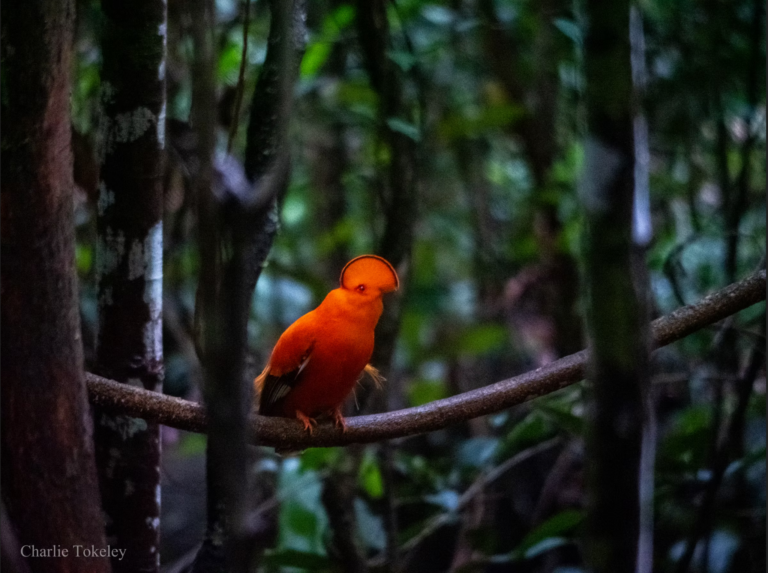

The Desert Vipers are set to continue their commitment to protecting and celebrating nature with the launch of the Desert Vipers Styrex 2026 Guyana Biodiversity Campaign, an exciting programme of community engagement and citizen science taking place during the ExxonMobil Global Super League (GSL).
Building on the success of our pioneering BioBlitz work during the DP World ILT20, delivered by Nature Wave, the campaign demonstrates how cricket can be a powerful force for environmental awareness, inspiring fans and local communities to connect with nature while contributing to meaningful conservation efforts.
Guyana – known as the Land of Many Waters – provides the perfect setting. Home to extraordinary wildlife, vast rainforests, and a global reputation for environmental stewardship, the country offers an incredible opportunity to showcase biodiversity to audiences both locally and around the world. Throughout the tournament, the Desert Vipers, alongside our partners including Fuelre4m, will deliver a series of activities designed to inspire, educate, and leave a lasting legacy.
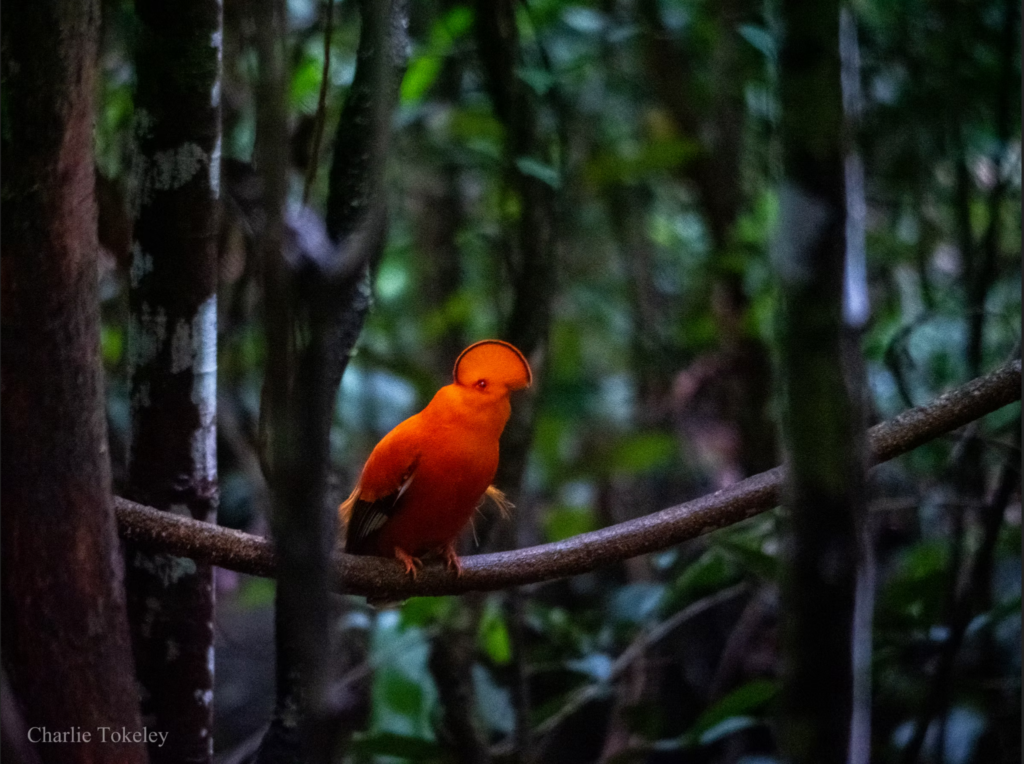
The campaign begins with a birdwatching experience along the spectacular Mahaica River, where Desert Vipers players will explore one of Guyana’s richest wildlife habitats alongside local experts. The event celebrates Guyana’s natural heritage while highlighting the importance of protecting these remarkable ecosystems.
The centrepiece of the campaign is a nationwide BioBlitz, running from 20–24 July. Schools, cricket clubs, environmental groups, and staff of the League’s Partners will work together to record as many species of plants and animals as possible using technology as part of a citizen science activation. Every observation helps build valuable biodiversity data while encouraging participants to spend time in the wildlife that exists in Guyana. The campaign also includes a special community event at Guyana National Park, where supporters will have the chance to meet Desert Vipers players before joining a guided BioBlitz to discover the biodiversity found within one of Georgetown’s most important green spaces.
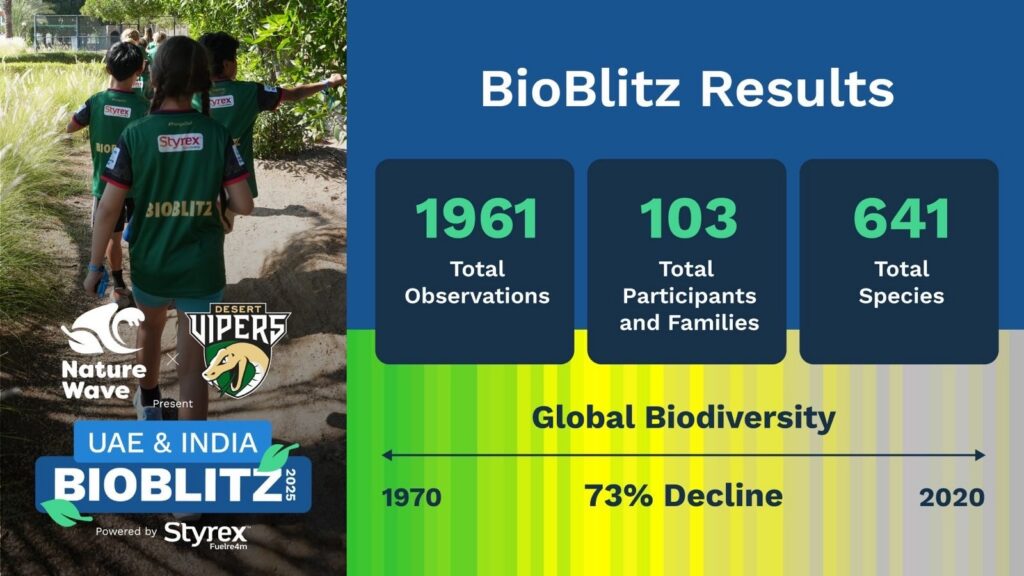
For the Desert Vipers, BioBlitzes have already proven to be a powerful way of bringing sport and nature together. In Season 3 of DP World ILT20, Desert Vipers hosted a BioBlitz at our Team Hotel, JA The Resort. In Season 4, we went international with the 2025 UAE-India BioBlitz powered by Styrex by Fuelre4m. Across the two events, 132 participants have come together to record 738 species in 2,271 observations – a remarkable citizen science effort.
Beyond biodiversity, the campaign focuses on creating a lasting legacy. At the conclusion of the tournament, player-worn match kit and surplus cricket kit will be donated to local cricket communities, supporting the team’s ambition of sending zero kit to landfill while helping young cricketers across Guyana.
Throughout the GSL, the Desert Vipers will also wear their striking Global Biodiversity Stripes match kit, designed by Professor Miles Richardson from the University of Derby, which highlights the documented 73% decline in average global wildlife populations since 1970 and reinforces the team’s message that Without Nature, There Is No Sport. The campaign will be supported by a comprehensive media programme and social impact reporting to ensure its influence extends well beyond the boundary rope.
The Desert Vipers Styrex 2026 Guyana Biodiversity Campaign is another important step in the Desert Vipers’ mission of playing with purpose for people and planet, by using the power of cricket to inspire action, strengthen communities, and help protect the natural world for future generations.
Vipers Voices: Nathan Smith’s Vipers story begins

Nathan Smith talks about joining the Desert Vipers, his early experiences with the team and what he hopes to bring to the campaign.
Nathan Smith replaces Kyle Jamieson for Global Super League
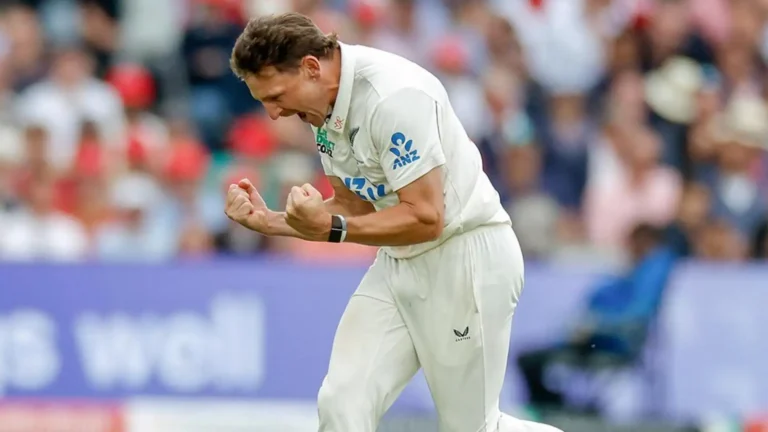
New Zealand’s fast-bowling all-rounder Nathan Smith has been recruited by the Desert Vipers for the ExxonMobil Guyana Global Super League following the withdrawal of compatriot Kyle Jamieson from the tournament.
Smith, along with Black Caps team-mate Daryl Mitchell, is playing the role of an advance party for the Vipers as the duo are in Georgetown for a One-Day International (ODI) series against the West Indies.
And their presence at Providence Stadium will allow them to feed vital first-hand experiences back to the rest of the Vipers squad when it assembles for the tournament in less than a week.
Speaking to the Vipers Voices podcast on the eve of the ODI series, Smith talked about his initial observations of the conditions.
“We had a couple of training sessions, one under lights and one in the daytime. There is quite a bit of rain around as well, which actually impacts it quite a bit, I think,” he said.
“The wickets are a little bit soft and obviously quite slow. From a seam bowling point of view, I think it will look like we have to bowl nice and straight and use the wicket. The wicket will be our friend, but I think spin will play quite a big part as well.”
The fast bowler said he was eager to share his insights with the Vipers ahead of the GSL, particularly given the tournament’s short format and the need for teams to adapt quickly to local conditions.
“Hopefully any sort of information I pick up here over the next three games will come in handy and I will be able to relay some feedback to the (Desert Vipers) boys around how quickly we can adapt and how we can best use the facilities.
“I think it is such a short tournament, so whichever teams adapt and adjust to the conditions and make the most of those conditions will, along with a little bit of individual brilliance, have the best results.
“Hopefully we can get off to a flyer and win those first couple of games and get ahead of the pack.”
Smith was named New Zealand’s Player of the Series in his side’s impressive 2-1 Test series win over England earlier this summer. He finished as the series’ leading wicket-taker with 16 wickets and credited part of his success to having wicketkeeper Tom Blundell stand up to the stumps to limit the batters’ movements.
Smith said that although the GSL would be played in a different format against different opposition, the same tactic could still prove effective in Guyana.
“It was definitely a play that worked really well,” he said. “Obviously, the thought behind it was to keep Joe Root and Harry Brook in their crease because they do like to be quite busy and proactive, and it worked really well for us.
“And it was lucky those two pitches that we employed it on were slower in terms of bounce that was not too steep, so Tom Blundell (the New Zealand wicketkeeper) could handle it pretty well.
“I think in Guyana the pitches will not bounce as much either and they will be a bit on the slower side, so it is definitely something we could think about if players are using their feet. It worked really well for us in the Test, so it is definitely something we could think about if guys are looking to use their feet and move around quite a bit.”
Having the wicketkeeper up at the stumps is not something fast bowlers traditionally like to see as it brings with it the suggestion they are not bowling quickly enough.
But Smith said that once he got over that thought, it was a tactic that he grew to appreciate.
“I definitely think there was a little bit of managing the ego initially because you do want to see the ball fly through, but at that time it is about doing what is best for the team,” he said.
“It definitely takes a little bit of time to get used to visually, and with the keeper being up in terms of (a bowler like myself) trying to find the right lengths.
“But once you get a bit of rhythm with the keeper up, it is quite nice because you do feel like you can really dominate the batter with the keeper (and his presence) making them stay in their crease.”
While he has played eight Tests and 18 ODIs for his country, Nathan only made his Twenty20 International debut earlier this year against Bangladesh.
Smith said the hot and humid conditions in Chattogram and Mirpur were unlike anything he had experienced before, forcing him to adapt quickly — a challenge the Vipers will also face in Guyana.
“I had been to Bangladesh before, for an ICC Under-19 World Cup and I think that was (January and) February (2016), so it was a little bit cooler then, but the heat (in April and May of this year) was next level and I had never experienced anything like it.
“You walk outside (and) you start sweating. On the plane over as well, I actually had a little bit of sickness, so I went into the first game a little bit underdone in terms of how I was feeling and that was tough. But they (Bangladesh Cricket) tried to make the pitches a little bit more seam-friendly to support their bowlers because Bangladesh has a strong seam bowling unit at the moment.
“I just had to adjust to the conditions and the T20I experience was cool.
“I have played a bit of Twenty20 cricket now and feel like I have got an understanding of my game. But it was cool to, at the end of that, say, ‘I have played all three formats internationally’ and hopefully there are a few more Twenty20s out there for me.”
Smith added that compatriot and fellow Vipers GSL squad member Bevon Jacobs, who also toured Bangladesh earlier this year and played a match-winning innings in the Mirpur T20I when he made an unbeaten 62 in 31 balls, would be a major asset for the Vipers in Guyana.
“He is a seriously powerful player,” said Smith. “Coming up against him when he plays for Auckland, he can take the game away from you.
“I know in New Zealand, with small boundaries and good pitches, he is someone you are really worried about in terms of coming in at four or five. He is a big, strong, strapping lad who can hit the ball hard and he is a great lad as well. He is good to have around and is an athlete in the field.”
The Desert Vipers stint will mark Smith’s first experience of franchise cricket, and he said he was looking forward to the GSL, the challenges ahead and the strong support for the sport in the Caribbean.
“I have seen a bit of the CPL (Caribbean Premier League) and they call it the Biggest Party in Sport, so hopefully we get a good crowd in and there is lots of music and lots of energy.
“We will get a bit of an idea through these ODIs as well, I think, but hopefully there is a lot of noise, a lot of atmosphere and it is a lot of fun.”
Vipers Voices: Shadab Khan on leading the Vipers in GSL 2026

Shadab Khan discusses captaining the Desert Vipers at GSL 2026, his leadership approach and the challenge ahead in Guyana.
Shadab Khan appointed Desert Vipers captain for GSL
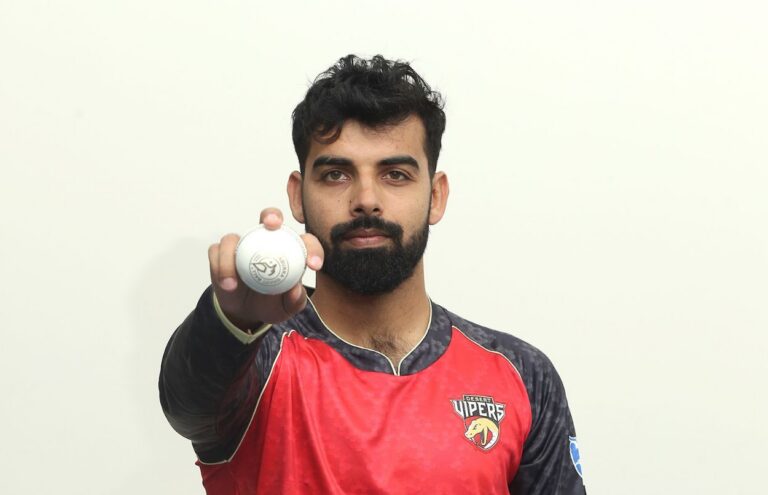
Pakistan leg-spinning all-rounder Shadab Khan has been appointed Desert Vipers captain for this month’s ExxonMobil Guyana Global Super League.
The 27-year-old replaces injured Australian all-rounder Chris Green in the role, and will lead the side in the five-team tournament, which begins on 23 July at Providence Stadium in Guyana. Joining the Vipers are hosts and defending champions the Guyana Amazon Warriors, plus the San Francisco Unicorns, the Lahore Qalandars and the Perth Scorchers.
Speaking to the Vipers Voices podcast, Shadab said he was excited to take on the captaincy but disappointed by Green’s withdrawal as the two formed a close bond playing alongside each other in the Pakistan Super League (PSL) with Islamabad United.
“He (Chris Green) is a very good friend of mine and I am very sad for him because I know from my own experience how hard injuries can be,” said Shadab. “Greeny is the type of player you want on your team because he is someone who gives everything to the team.
“While I am happy to get the opportunity to lead the team, I am also sad for my friend.”
Shadab brings extensive captaincy experience, having led Islamabad United in the PSL in the past seven editions of the tournament, including their title-winning campaign in 2024, when he was named player of the tournament.
When asked about his leadership style, he said he believed in one-on-one conversations with players to help build their confidence.
“As a captain I think I do not chat much in the group, I prefer to have individual conversations with the players.
“I just feel it is important to give all the players the freedom to enjoy themselves because everyone is a professional and everyone has played a lot of cricket, especially the squad I have had under me (Islamabad United in the Pakistan Super League) in the past. So, with that type of player you do not need to tell anyone what to do, you just need to have good communication skills and have individual conversations.
“I personally believe in focussing on the individual rather than the group, because when you give players clarity as individuals, that helps to build their confidence and self-belief.”
Shadab Khan said he most admired Ricky Ponting as a leader, a player who led Australia to two ICC Cricket World triumphs in 2003 and 2007, with both campaigns seeing his side remain unbeaten.
“I have always liked Ricky Ponting and I always heard good things about his leadership qualities,” said Shadab. “I think he is amazing and I am fortunate that I have met him and had chats with him about the game. His leadership skills can be seen even when he does cricket commentary because you can sense how he is far ahead of the game. So I always look up to him,” he added.
Shadab said he was also looking forward to working again with Desert Vipers GSL head coach Azhar Mahmood, who has had an important role in helping to steer Shadab’s career with both Islamabad United in the PSL and the Pakistan national team.
“I think our association began when I joined the Pakistan national team and he was our bowling coach,” he said. “So, we worked together for three to four years of my initial career.
“When I entered international cricket, I needed a mentor to show me the ropes and he was like a big brother who guided me and helped me negotiate that important period in my life. So, I have a big brother type of relationship with Azhar Mahmood.
“Then, when he returned as (Pakistan) head coach we had a very good relationship and the communication was great. We had some good conversations with each other, we have now worked together for over 10 years and it has been a really good run.”
Shadab is currently playing for Lancashire in the T20 Blast – ironically filling the spot vacated by the injured Chris Green – in England and Wales and he said the tournament was not just an end in itself but also a way of ensuring he was cricket-hardened for the GSL.
“It is always good to get momentum going into Twenty20 cricket, especially because I was playing ODIs (in a One-Day International series for Pakistan against Australia in Pakistan) before this. A Twenty20 tournament like this (the T20 Blast) is a type of competition where I can get momentum or form behind me before a GSL-type of a tournament, because the GSL is very short.
“You have to be spot on from the very first ball as a bowler or batter because you do not have much time to get back that momentum (with four group games in a week).
“The (T20) Blast is a difficult competition to play, especially because some grounds have small boundaries. As a batter I am fine, but as a bowler it is hard. Therefore, this is providing me with good preparation for the GSL.”
A key member of Pakistan’s national side, Shadab Khan has built an impressive international career, playing six Tests, 73 ODIs and 124 Twenty20 Internationals (T20Is), taking more than 200 wickets across formats for his country.
After shoulder surgery in July 2025 kept him out for several months, the leg-spinner completed a tough rehabilitation programme and made a strong return with Islamabad United in the PSL, scoring 173 runs at an impressive strike-rate from the lower middle order and taking 17 wickets, the third-highest tally in the tournament.
He said the injury has changed the way he approached the game.
“It was a good season in the PSL, individually and, as a team, we did well and I think everything is going so well (for me personally) this year.
“I think now I enjoy my cricket differently than how I did before my injury because when a major injury happens to a player and you come back after you have done your rehab and everything, (then) you know that playing is a bonus.
“I feel it is a bonus playing cricket now, because when I had the surgery and everything, I thought I would never be the same as before the injury, but in fact I am really enjoying my cricket a lot.
“I think when you come back in after injury at this stage it is more about the mental side of things. Obviously, you need skill, and obviously there is the physical side of things, but mostly it is about mental strength. I think after the injury there has been a change in my cricket, and I feel I am seeing the game differently now.”
Shadab said he was also keen to complete what he called “unfinished business” with the Desert Vipers. He played for the franchise in the DP World ILT20 in 2024, the only year when the team failed to qualify for the play-offs, and his personal form was also not at its peak.
“I think it was a disappointing season for me as well, because during that season I played maybe three or four games,” he said. “I did not do well or perform as I wanted to, and the team also did not qualify.
“The Vipers franchise is one of the best. Wherever they play, they are the best. Obviously, I have unfinished business with the Vipers as things did not go the way I had hoped the last time I played for the team.
“So hopefully, now in the GSL, I can show the Vipers fans how good I am and how good the Vipers team is both in the (DP World) ILT20 and around the world. Our Vipers have already done so well in the (DP World) ILT20 and hopefully that unfinished business will finish here.”
Bevon Jacobs adds batting firepower to Vipers’ GSL squad
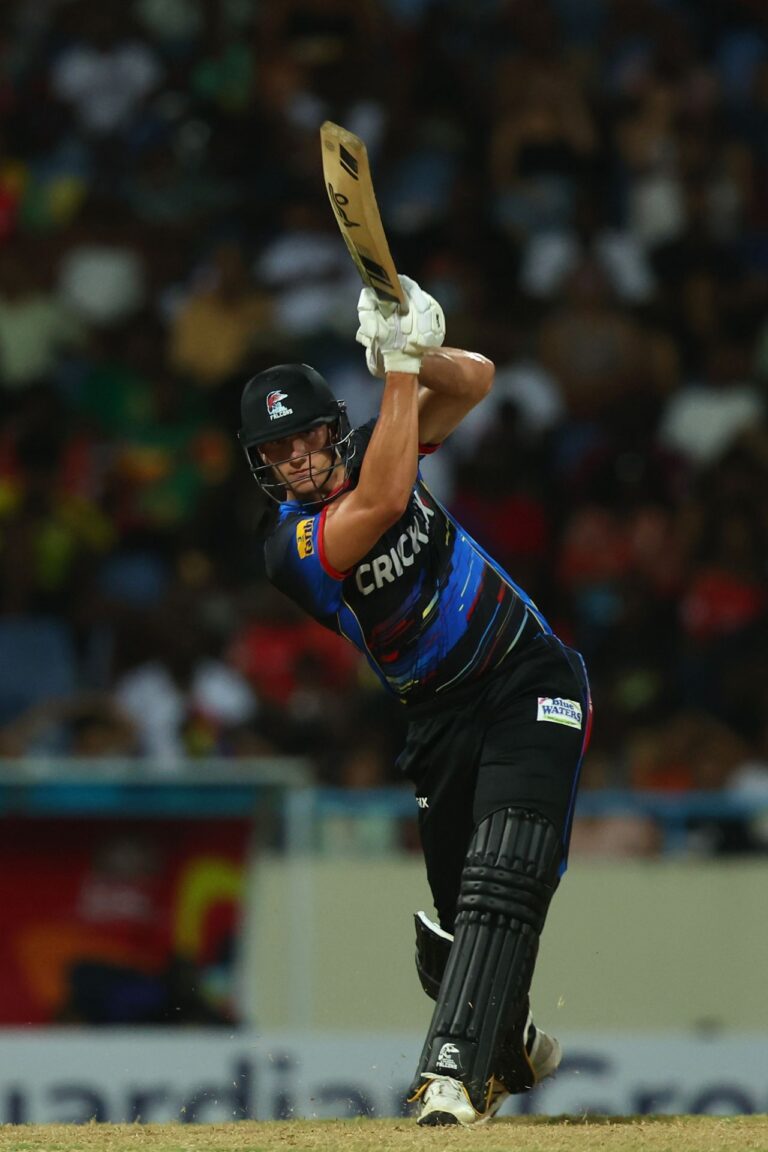
New Zealand middle-order batter Bevon Jacobs has joined the Desert Vipers for the ExxonMobil Guyana Global Super League 2026 (GSL), where he is expected to play a key role as a finisher.
The 24-year-old, who made his New Zealand debut in the shortest format last year following a stunning season in the domestic Super Smash for Auckland in 2024/25, has already enjoyed successful stints with the Antigua and Barbuda Falcons in the Caribbean Premier League (CPL), the Quetta Gladiators in the Pakistan Super League, and MI Emirates in the DP World ILT20. He was also included in the Mumbai Indians squad for the Indian Premier League.
Speaking on Vipers Voices, Jacobs discussed how he had shaped his game to become an effective finisher.
“I think in T20 cricket, the game is always fast-paced no matter where you are batting,” he said.
“The most difficult part about being a middle order or lower middle order finisher is you never really know how many balls you are going to face. Sometimes you can get caught up in wanting to maybe take an extra ball to settle in, but often you do not get that luxury. You come in at seven, for example, and you have got six balls left in the innings.
“My role then is just to say, ‘What is the most impact I can create in this game?’ Then it no longer becomes about milestones, like fifties, half-centuries, centuries, all that sort of stuff. It is more about what impact can I bring to the game?
“And leaning on the experience of the other guys, I think helps me a lot. And just having that role clarity and being able to talk to someone like Daryl Mitchell out in the middle and just being like, ‘Okay, mate, what do you want from me here?’ Or ‘I am thinking this,’ and just bouncing those ideas off each other.
“I think (that approach) is really helpful for my game. And obviously that filters back down into Auckland cricket for when I play the Super Smash. But I think it is about making as much impact in as little time as possible because it is not often that I am going to get 40 balls to bat.”
Jacobs added that preparing to be a finisher went beyond match-day tactics. He said he also trained with that mindset in the nets, knowing he may be needed to attack from the first ball and find the boundary immediately.
“Sometimes it (training) does look like that because realistically, that (hitting boundaries from ball one) is the way it is going to be. Obviously, you try and warm up a little bit first but sometimes in the nets you do just go in there and say, ‘What is my field, I have got six balls here, this is a scenario, this is how many runs I need and can I make it happen?’
“Every now and again, the game is obviously going to ask you to improve in different ways, whether that is a change in technique in some area or maybe adding a new shot into your game. But yes, sometimes with power hitting, the training can be just as simple as going in there and seeing if I can hit the first ball for six.”
The Kiwi batter admitted that one of the toughest parts of being a finisher was accepting the possibility of failure, as the role often required a high-risk approach.
“I think initially it was not that easy (to reconcile to the possibility of failure and the risks of having to go in and swing hard from the start). And I think it is tough for anyone at the beginning to grapple with that, because obviously what you want to do for your country or for Auckland (or whichever team you are playing for) is to score runs.
“But sometimes, it is more about the impact that you make. A score of 17 off 10 or 11 balls at a strike rate of 170 – although that is considered low these days, depending on where you are batting – or an impact like hitting three sixes in nine balls, is going to do more good for your team than getting more runs at a lower strike rate.
“It is about what you can give to the team. And I think averages in the format are probably not looked at as much as they once were compared to strike rates. So, I think the game is adapting to now banking on a particular player having an impact in a short amount of time rather than averaging 40 every game but not striking high enough.”
Jacobs is among the Desert Vipers players with previous Caribbean experience, which is regarded as important for success in the GSL, and he said he hoped to share those lessons in the Vipers dressing room.
“What I have learnt from the experience of the CPL is how to bat in different conditions, which is something that is hard to come by, especially for someone based in New Zealand. And I think having these opportunities has been a privilege. It has been really awesome for me to try and expand my game in different continents and different conditions.
“I have learnt a lot, especially how to play spin which is obviously a massive factor in the Caribbean, and I am sure will be in the GSL as much as it is in the CPL. So it is about just taking those learnings into the game and trying to adapt quickly. I also know that I can lean on the other guys who have played there (Guyana) before, especially someone who is as experienced as Daryl Mitchell, who is going to be there as well.
“So I am looking forward to that aspect and just trying to grow that part of my game continuously.”
Looking ahead to next month’s tournament, Jacobs said he was confident the Desert Vipers could secure a second trophy in 2026, adding to their DP World ILT20 triumph in the United Arab Emirates in January.
“I think that is the only way you should think,” he said. “I do not think any other thoughts (should) enter our minds.
“We have got a strong group and we have got every chance to win as much as any other team.
“So I think we just put all our effort and energy into prepping well and into each other and I have got no doubt that we will be able to put the performances together to get over the line and win that trophy.”
Vipers Voices: Bevon Jacobs ready for GSL 2026

Bevon Jacobs talks about preparing for GSL 2026, settling into the Desert Vipers squad and what he is looking forward to in Guyana.
Vipers Voices: Rilee Rossouw on the challenge ahead in GSL 2026

Rilee Rossouw previews the challenge awaiting the Desert Vipers at GSL 2026 and shares his expectations for the tournament.
Arthur: “Embrace the conditions and prepare well”

Decorated cricket coach Mickey Arthur has coached four international teams and knows what it takes to succeed at the ExxonMobil Guyana Global Super League (GSL), having led Bangladesh’s Rangpur Riders to the title in the tournament’s inaugural edition in 2024.
Ahead of the Desert Vipers’ first appearance at Providence Stadium, Arthur offered several key pieces of advice.
Speaking to Vipers Voices Arthur said: “My advice would be embrace the conditions. Embrace it. Guyana is a different place to go to. Enjoy the carnival atmosphere. Enjoy the noise. Enjoy the sounds. Enjoy the colour.
“But embrace the conditions because it is going to be different to what you have experienced before. Embrace the conditions, prepare well. And I see no reason why the Vipers, having had a look at the composition of their side, will not have a very good chance in this tournament.”
New Zealander Tom Bruce, a member of the Desert Vipers’ DP World ILT20-winning squad in Season 4, also joined the Vipers Voices discussion on the team’s strategy for the Guyana tournament. Bruce brings previous GSL experience, having captained New Zealand’s Central Stags last year, Season 2 of that tournament, and he said he was confident the Vipers could adapt to the conditions and perform well in Guyana.
“I honestly think the squad that the Vipers have assembled will be very well equipped to deal with these conditions,” he said. “I think a lot of the players would have played on the slower surfaces that will be expected and spin is going to play a big part. I think they are a very well-balanced team so I certainly think they will be able to put their best foot forward.
“(Conditions) can be tough, (and) can be challenging and there will be spin throughout the middle (overs of a batting innings), but having your boundary options and knowing how to rotate the strike as well is massive. I think they will be well equipped to deal with the conditions that are in front of them.”
Mickey Arthur is currently Director of Cricket at English county side Derbyshire, the latest role of an incredible coaching career. He has been head coach of four different international teams: South Africa, Australia, Pakistan and Sri Lanka.
He was on the ground with Rangpur for their trophy-winning effort in 2024 and then managed the team remotely last year when they were runners-up to Guyana Amazon Warriors, and Arthur said having a core of players with Guyana experience was a key reason for their impressive efforts.
“I think in year one we kind of found a formula. We lost our first game against Hampshire and then found a formula that we thought would work for us and it was very simple: bat first, (put) runs on the board and then try and strangle them (the opposition) with your spin.
“Our seam bowlers went straight at the stumps and kept the stumps in play all the time as the wicket was quite slow and (the ball) tended to skid on and stay a little bit low. So, again, that was the formula that we worked with.
“And then (in Season 2) we tried to get players in that complemented the game plan and the strategy that we were going to use. We got to the final again and then lost it but it kind of worked in the way we wanted it to in terms of conditions, in terms of playing personnel that we employed and in terms of our game plan.”
The Desert Vipers’ four group stage matches of the GSL include three nighttime games and one match during the day. Both Mickey Arthur and Tom Bruce explained how conditions do vary between the two timings.
“It (the conditions) definitely does vary (between day and night matches),” said Arthur. “And as the competition goes on, you start playing on used wickets. So, early in the competition, you get the better of the conditions.
“What we did find was there was a lot of dew around in the evening games. The ball potentially did skid on just a little bit more and the ball got wet for the spinners so that was tough to work with.
“But we trained for that, we would dip balls in water to make sure that our spinners could grip the ball and had practised that. I thought in our preparation, the one percenters we used there were spot on. If we were going to employ our game plan and strategy, invariably the spinners were going to bowl with wet balls and they did it and controlled it really, really well.
Tom Bruce added: “The (conditions for the) day games felt very slow and it was quite difficult to score. And when it did get under lights, obviously, it did skid on a bit more. There was a bit of a dew factor as well.
“It certainly felt a bit easier (to bat) under lights. Albeit, you still had a lot of very good bowlers that were able to extract turn under lights or nip the ball off the seam.
“I like to think that the best teams exploit conditions and are also able to adapt to them as quickly as possible, which in the end is probably why you saw that Guyana Amazon Warriors team take out the title. I thought they were very well-balanced and they had a lot of superstars across the park.”
The Global Super League in Guyana is a five-team event that will take place at Providence Stadium from July 23 to August 1. Alongside the Vipers will be hosts and defending champions the Guyana Amazon Warriors, the Perth Scorchers, the Lahore Qalandars and the San Francisco Unicorns.
Speaking to Vipers Voices both Tom Bruce and Mickey Arthur admitted they were fans of the tournament and the coming together of top franchise teams from across the globe.
Mickey Arthur said: “I think it is a great concept and I think it is very well supported, particularly the matches involving the Guyana side. Financially, it is very well supported. Guyana is now a wealthy country with them finding oil there. They have thrown a bit of money at the competition as a kind of advertisement for Guyana as a country.”
Arthur added that the tournament being conducted in one place was a huge advantage.
“It (GSL) is very well run, very well organised. So logistically, it just works very well. You are in one hotel, it is one venue, training facilities are good. So it was a pleasure to be part of a competition that has been so well organised. And it is one that certainly provides a lot of excitement, especially to the people of Guyana.”
Tom Bruce added: “I thought it was brilliant. Giving teams the chance to play against other teams and other franchise leagues from other parts of the world is fantastic. Especially for us (Central Stags) last year, being a domestic team, the majority of the team had not played any franchise cricket before.
“It certainly opened guys’ eyes to what it was all about and how you had to go about your business there. So, for our team, it was an unbelievable experience. And I certainly think it is a great concept, a great tournament to bring the best teams from around the world and their respective leagues together to crown one champion.”